
In Vitro DMPK/ADMET Assays
Accelerate your drug discovery and development pipeline with research- and regulatory-focused
drug-drug interaction and toxicity studies.
Featured assays
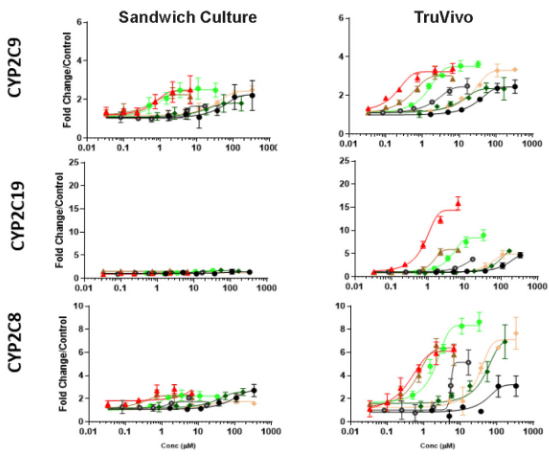
CYP Induction (CYP2C)
Determine CYP2C enzyme activity with greater sensitivity using TruVivo.
Common Assays We Offer
DMPK and ADMET Assays
In vitro ADMET assays are used to profile the pharmacokinetic properties of a drug candidate, providing essential insight into the metabolism and potential interactions of new drug compounds. ADMET helps identify Absorption, Distribution, Metabolism, Excretion, and Toxicity as a key part of Drug Metabolism and Pharmacokinetics, also known as DMPK.
We offer customized research solutions, with options for high-throughput compound screening. We can provide specialized expertise in the assessment of nanoparticles and oligonucleotide molecules.
Evaluating new drug candidates for their potential to induce Cytochrome P450 (CYP) enzymes is an important step in the drug discovery and development process. Our CYP induction assays can help to accurately predict the metabolism of drugs in the body.
Our services team offers standardized protocols for two CYP inductions assays, both based on FDA guidance, for assessing gene expression fold-change and enzyme activity of CYP induction.The evaluation focuses on the primary CYPs, such as CYP1A2, CYP2B6, and CYP3A4/5, with further assessment of other CYP2C enzymes recommended if significant induction of CYP3A4/5 occurs.
Accurate in vitro prediction of hepatic clearance (Clint) is pivotal for successful drug development. Designing drugs for oral administration with low first-pass metabolism and longer half-lives requires addressing challenges in predicting slow metabolism and low Clint values.
TruVivo, an optimized in vitro hepatic system, addresses the shortcomings of standard 2D culture for accurate Clint assessment, providing a solution for obtaining more relevant Clint data with high IVIVE accuracy.
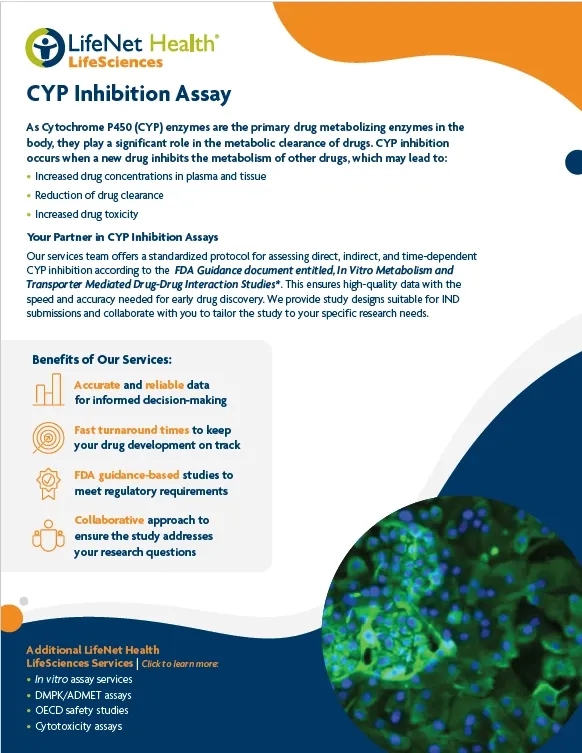
As Cytochrome P450 (CYP) enzymes are the primary drug metabolizing enzymes in the body, they play a significant role in the metabolic clearance of drugs. CYP inhibition occurs when a new drug inhibits the metabolism of other drugs, increasing drug concentrations in plasma and tissue, reducing drug clearance, and increasing drug toxicity.
Our services team offers a standardized protocol for assessing direct (IC50), indirect (IC50 Shift Assay), and time-dependent CYP inhibition assays based on FDA guidance, ensuring high-quality data with the speed and accuracy needed for early drug discovery.
Studies conducted to measure metabolic stability of drug products in the liver can be used to inform drug design, predict intrinsic clearance (Clint), determine half-life (T1/2), and support preclinical animal testing and IND submissions.
Learn how our TruVivo 2D+ hepatic system can add important information to understanding the metabolic stability of a compound over extended exposure times in a more in vivo like environment.
In drug discovery, accurately predicting how a drug behaves in the human body is critical. Plasma protein binding (PPB) plays an essential role in regulating drug availabilty, clearance, distribution, and potential interactions.
Our services team offers a standardized protocol for assessing PPB, ensuring high-quality data with the speed and accuracy needed for early drug discovery.
In drug discovery, accurately predicting how a drug behaves in the human body is critical. Microsomal protein binding (MPB) plays an essential role in drug-drug interactions (DDI). Recent guidelines recommend measuring the unbound drug fraction (fu(mic)) to assess DDIs accurately.
Our services team offers a standardized protocol for assessing MPB, ensuring high-quality data with the speed and accuracy needed for early drug discovery.
For new drugs, it is crucial to determine how much of the administered dose will reach systemic circulation and result in the desired efficacious effect, therefore it is essential to develop pharmacokinetic models that accurately predict bioavailability (%F).
Learn how we utilize reliable Caco-2 and EpiIntestinal in vitro models to accurately determine intestinal absorption.
LifeNet Health offers a transporter interactions assay based on the FDA Guidance document entitled, In Vitro Metabolism and Transporter Mediated Drug-Drug Interaction Studies.
Why partner with LifeNet Health® LifeSciences for your ADMET studies?
Our experienced team is committed to helping you identify and customize Absorption, Distribution, Metabolism, Excretion, Toxicity (ADMET), Drug Metabolism, and Pharmacokinetic (DMPK) Assays that accurately assess your drug candidate using methods based on current regulatory guidelines.
Our expansive services portfolio includes standardized methods as well as advanced methodologies only available to our partners. Our ability to utilize directly sourced, high-quality human tissues sets us apart, enabling DMPK/ADMET data that more accurately reflects human biology.
Our assay services team is committed to performing IND-enabling studies and delivering high-quality data with timely turnaround—at every stage of your project.



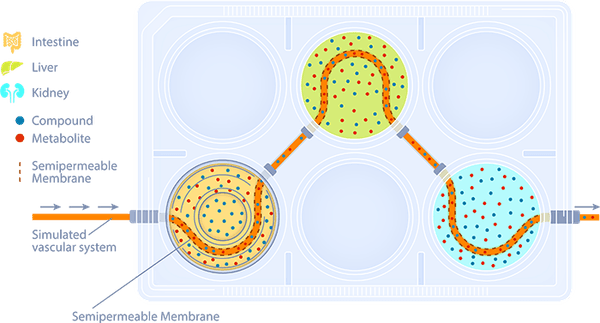
Test up to three organs at once with our integrated multi-organ microphysiological system (MPS)
Expedite the evaluation of chemical and drug substance toxicity and gain insights into systemic impact using our integrated MPS platform. Our MPS platform provides human-relevant results because human tissues are used to recapitulate in vivo conditions.
Select from multiple combinations of 2D and 3D cellular and tissue models/cultures including:
• Intestine-Liver-Kidney
• Intestine-Liver-Thyroid
• Skin-Liver-Kidney
• Lung-Liver-Kidney
Expert regulatory
guidance

Resources
Looking for additional information on our assays?